Art as a Bridge to Engagement: What the Data Shows
In partnership with Project Fatherhood, Upward Together explored how creative practices shape engagement within a processing group setting.
This work took place at the CAPO Center in West Hollywood, where participants gathered in a shared space for reflection, dialogue, and hands-on creative practice.
These workshops were made possible through the support of Arts for Healing and Justice Network, whose investment allowed us to both facilitate the experience and evaluate its impact through participant surveys.
What emerged was clear:
Art changes how people access engagement.
What the Data Revealed
Increased Understanding
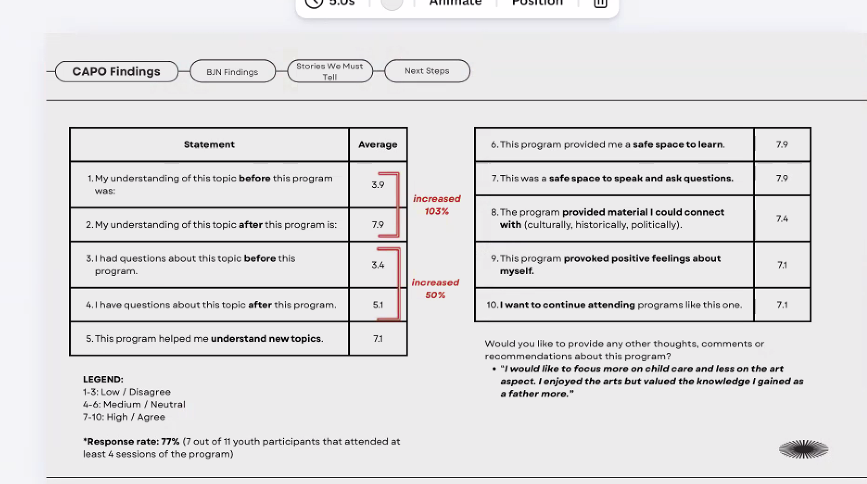
Participants reported a significant increase in understanding of core topics after the program, with some measures more than doubling. Creative practice supported not just expression, but comprehension.
Greater Willingness to Participate
After the program, participants were more likely to ask questions and engage. Art reduced pressure and created a more open, participatory environment.
A Sense of Safety and Belonging
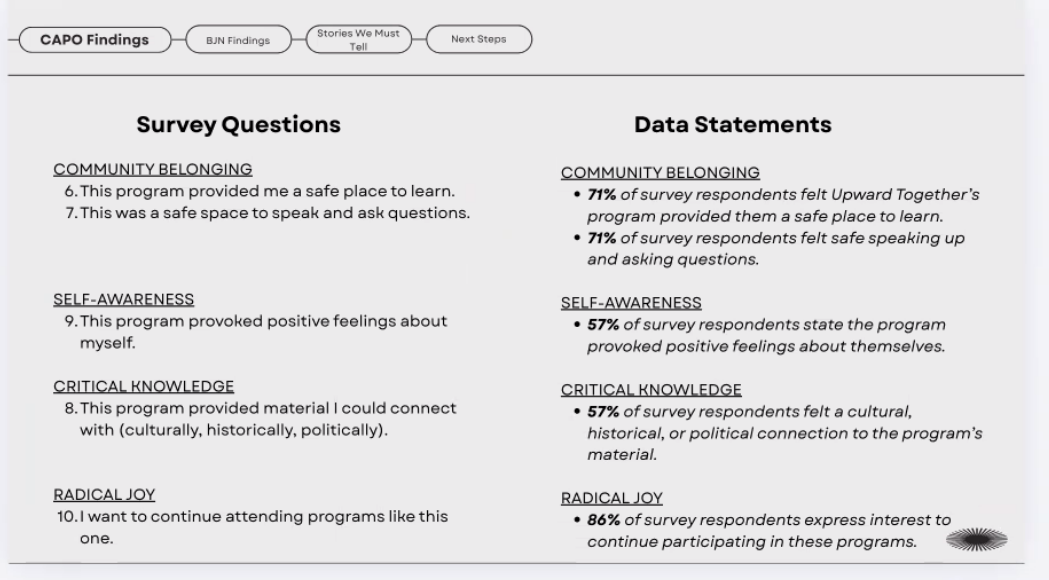
71% felt the program provided a safe space to learn
71% felt safe speaking up and asking questions
Safety is foundational in processing spaces—and here, it was actively built.
Growth in Self-Awareness
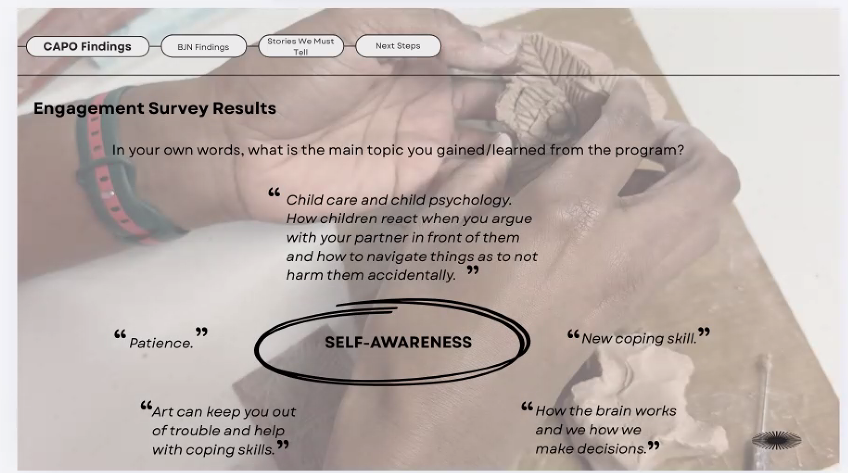
Participants consistently identified self-awareness as a central takeaway, alongside patience, coping skills, and understanding how the brain works.
Cultural and Personal Relevance
57% reported a meaningful cultural, historical, or political connection to the material
This underscores the importance of programming that reflects lived experience.
Sustained Interest
86% expressed interest in continuing programs like this
Engagement extended beyond the workshop—it created momentum.
What Participants Shared
Participant reflections revealed both practical tools and internal shifts:
“Art can keep you out of trouble and help with coping skills.”
“New coping skill.”
“Patience.”
“How the brain works and how we make decisions.”
And most notably:
“Self-awareness.”
Why This Matters
Processing groups often rely heavily on verbal participation—but not everyone accesses reflection through words alone.
Art offers:
a non-verbal entry point
agency in how participants share
a grounded, hands-on way to stay present
It doesn’t replace dialogue—it expands access to it.
With Gratitude
We are deeply grateful to Arts for Healing and Justice Network for their support in making this work possible.
Their investment funded these workshops and enabled us to capture meaningful data, translating lived experience into measurable insights that inform future programming.
Looking Ahead
This work points to a larger opportunity:
Creative practice can be a core strategy for engagement—not an enhancement.
At Upward Together, we are continuing to build programs that are:
accessible
trauma-informed
grounded in real-world application
Because when people are given multiple ways to engage, they don’t just participate—
they connect more deeply, reflect more honestly, and return.