Creating Space for Self-Awareness
Self-awareness doesn’t emerge from information alone.
It develops in environments where people feel safe enough to reflect.
At CAPO Center last summer and fall, we saw this play out in real time.
Upward Together partnered with Project Fatherhood, with support from the Arts for Healing and Justice Network (AHJN), to offer a series of creative, reflective workshops.
Upward Together creates space for nervous system regulation through art and mindfulness. Based in Los Angeles, the work spans schools, workplaces, and community settings—supporting emotional well-being in a world shaped by stress and constant demand. Each program is guided by teaching artists who bring their own creative language into the room, from sculpture and illustration to drawing and reflective art-making.
At CAPO Center, these art-based experiences were part of a group processing space focused on parenting—offering participants a way to reflect not just through conversation, but through the act of making.
The pace was slower. There was space between responses. Participants drew, wrote, and talked as a group.
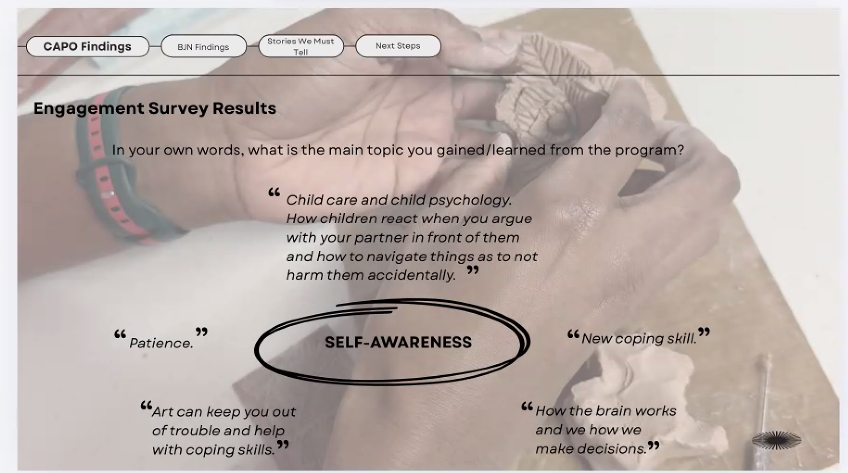
When participants were asked what they gained from the program, their responses were consistent.
They talked about self-awareness.
“Patience.”
“New coping skill.”
“How the brain works and how we make decisions.”
Again and again, participants pointed to the same shift: they were beginning to notice themselves—particularly in how they respond in moments of stress, and how those responses show up in parenting and relationships.
That shift is also reflected in the data.
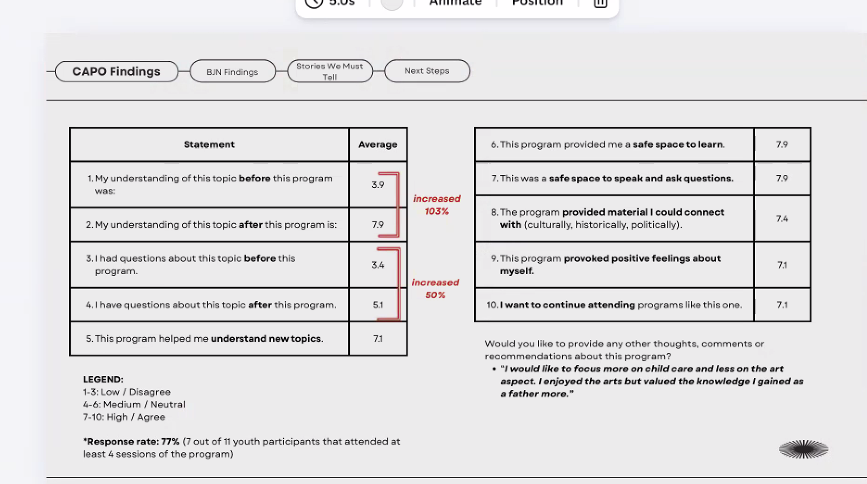
Over the course of the program, participants’ understanding of the topics more than doubled, increasing from an average of 3.9 to 7.9. At the same time, engagement increased, with participants asking more questions and seeking deeper understanding.
But knowledge alone wasn’t the shift.
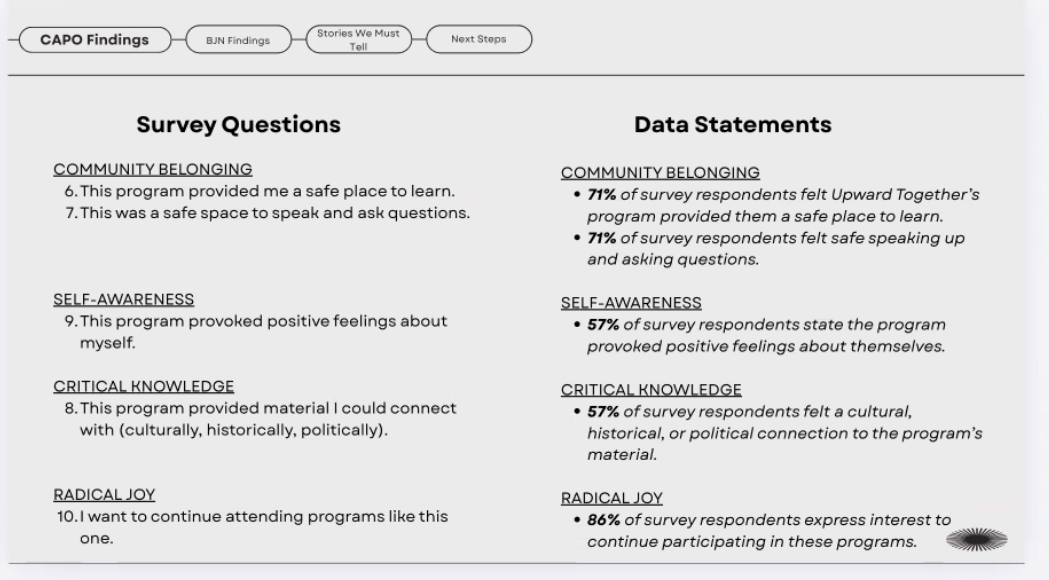
Participants reported feeling safe to learn, safe to speak, and safe to ask questions—something that can’t be assumed in all settings. Over half shared that the experience led to more positive feelings about themselves, and over half reported a meaningful cultural or personal connection to the material.
These conditions—safety, relevance, and openness—supported deeper reflection.
And perhaps most telling:
Most participants expressed a desire to continue.
At CAPO Center, the outcome wasn’t just increased understanding.
It was a shift in how participants see themselves, their reactions, and their impact on others—especially in the context of parenting.
And often, that’s where meaningful change begins.
Audio interviews and reflection slides are located below